Key Points
Dimpling is a visible indentation or puckering of the skin, and its meaning depends on where it appears, how long it has been present, and what other changes accompany it.
- Dimpling can be a natural feature, a temporary pressure mark, or a sign of changes in tissue beneath the skin.
- Skin, fat, connective tissue, ligaments, and muscle all influence the way an indentation looks.
- Breast dimpling that is new, persistent, or paired with other breast changes should be evaluated by a healthcare professional.
- Diagnosis may involve a physical examination, imaging, and sometimes a biopsy or other testing.
- Treatment is guided by the underlying cause; some dimples need no treatment, while others may call for medical, surgical, or cosmetic care.
What dimpling means and where it can occur
When people ask, “What Is Dimpling,” they are usually describing a small hollow, puckered area, or uneven texture on the skin. It may be barely noticeable or clearly visible, especially when the body moves or the skin is stretched. Dimpling can occur on the cheeks, chin, thighs, buttocks, breasts, abdomen, or around a scar. The appearance alone does not identify the cause.
How dimpling changes the appearance of the skin
Dimpling interrupts the usual smooth contour of the skin. A single indentation may look like a shallow depression, while several closely spaced depressions can create a rippled or pitted texture. Lighting, posture, muscle tension, and the angle from which the skin is viewed can all make the change seem more or less pronounced.
Some dimples are symmetrical and longstanding, which often makes them part of a person’s normal appearance. Others develop because tissue beneath the skin is pulling inward or because swelling changes the contour around it. The pattern and timing matter as much as the indentation itself, particularly when the change is new.
Common types of dimpling, including breast and facial dimples
Facial dimples are commonly seen in the cheeks or chin and may become more obvious with smiling or certain expressions. They can reflect the way facial muscles and connective tissues are arranged. Thigh and buttock dimpling is often associated with cellulite, a common surface-texture change that can appear across many body types.
Breast dimpling describes an indentation or puckered texture affecting breast skin. It may look like tiny pits or an orange-peel surface, sometimes called peau d’orange. A new breast-skin change deserves more attention than a stable facial dimple because breast dimpling can have several possible causes, including conditions that need prompt assessment.
Temporary dimpling versus persistent skin indentation
Temporary dimpling often follows pressure from clothing, bedding, a hand, or a prolonged position. It generally fades as circulation and tissue shape return to normal. Dimpling can also appear briefly when a person flexes a muscle, changes posture, lifts an arm, or makes a facial expression.
Persistent indentation remains in the same area or repeatedly returns without an obvious position-related explanation. A scar, tethered connective tissue, a change in fat, inflammation, or a deeper structural process may contribute. If the skin does not return to its usual appearance or the area is steadily changing, documenting it and arranging an evaluation is sensible.
Why new or changing dimpling deserves attention
A new indentation is a change from your personal baseline, so it is worth observing rather than dismissing. This does not mean that every new dimple is dangerous. It does mean that location, duration, associated symptoms, and recent events such as injury or surgery should be considered together.
Breast changes are especially worth discussing with a clinician. A useful breast skin changes guide can help explain why dimpling may have benign causes as well as causes that require further investigation, but online information cannot determine what is happening in an individual person.
The anatomy behind skin dimpling
Skin dimpling becomes easier to understand when the surface is viewed as part of a layered structure rather than as an isolated sheet. Skin lies over connective tissue and fat, with muscles, glands, blood vessels, and other structures beneath or within those layers. The layers can move together in some places and independently in others. Differences in this arrangement help explain why an indentation may be fixed, movement-related, or visible only under certain conditions.
How skin, fat, connective tissue, and muscle interact
The outer skin contains fibers that provide strength and elasticity. Underneath it, fat contributes volume and soft contour, while connective tissue helps hold neighboring structures in place. Muscle movement can shift the skin above it, and changes in muscle tension can temporarily reveal contours that are not obvious at rest.
If one layer loses volume, becomes swollen, or adheres more firmly to another layer, the surface may look uneven. The same visible dimple can therefore arise from very different mechanisms. A clinician evaluates the texture and movement of the area to understand which layers may be involved.
The role of ligaments and tissue tethering
Fibrous bands and ligaments connect the skin and deeper tissues in many parts of the body. Where these bands are short, tight, or attached at different depths, they can pull the skin inward and create a dimple. This is one reason some natural dimples become more visible with a smile or a change in position.
Tethering can also develop after healing. Scar tissue may contract as it matures, drawing nearby skin toward a deeper structure. In the breast, a deeper process can sometimes pull on supporting tissue and alter the surface. That finding is not a diagnosis by itself, but it is one reason a new indentation should be examined.
Why dimpling may appear when you move or change position
Movement changes the relationship between skin, fat, fascia, and muscle. Raising an arm can stretch breast tissue, flexing a thigh can tighten the underlying muscle, and smiling can activate facial muscles that reveal a cheek dimple. A contour that disappears when the muscle relaxes is often different from one that remains fixed.
Checking the area in more than one position can provide useful information, but repeated manipulation should not replace professional assessment. Note whether the indentation is present at rest, appears with movement, or changes when the skin is gently stretched. These observations can help a clinician understand the pattern.
How anatomy differs across the breast, face, thighs, and other areas
The breast contains skin, fat, glandular tissue, ducts, and connective structures, so a surface change may relate to any of several layers. Facial dimples are more closely tied to muscle movement and local anatomy. Thigh and buttock texture is often influenced by the arrangement of fat and fibrous bands, while a scar may create a sharply localized pull wherever it occurs.
That location-specific anatomy is why the same word—dimpling—does not describe one single condition. A healthcare professional considers the body area, age of the change, previous procedures, injuries, and accompanying symptoms before suggesting what to do next.
What causes dimpling
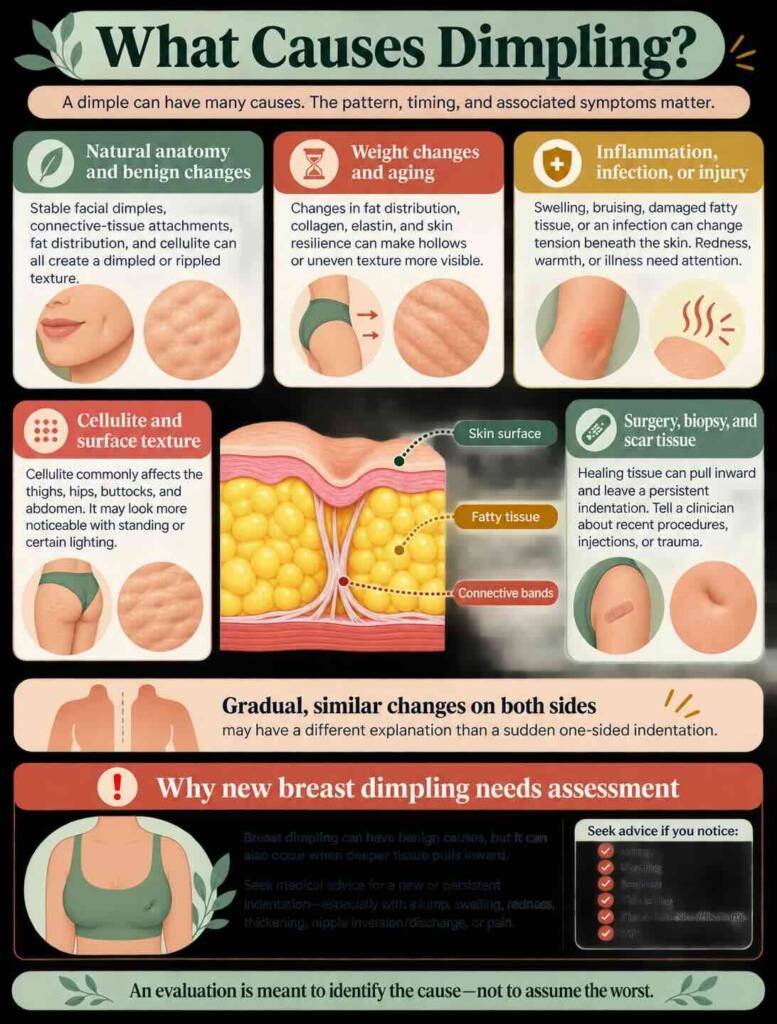
Dimpling has a broad range of causes. Some are natural variations in anatomy, while others follow changes in weight, aging, inflammation, injury, surgery, or scar formation. Breast dimpling deserves particular care because harmless tissue changes and more serious breast conditions can sometimes look similar from the outside.
The safest approach is not to guess from appearance alone. Instead, compare the area with its usual appearance, consider recent events, and seek an examination when the change is new, persistent, or accompanied by other symptoms.
Natural or benign causes of dimpling
Some dimples are present for years and remain essentially unchanged. Facial dimples are a familiar example, but small stable indentations can occur elsewhere because of normal differences in connective-tissue attachments or fat distribution. Cellulite is another common, noncancerous reason skin may look dimpled or rippled.
Benign breast conditions may also change the contour of the skin. Cysts, fibrocystic changes, inflammation, or damaged fatty tissue can affect the tissue beneath the surface. “Benign” means noncancerous, not that every unexplained change should be ignored; a clinician may still need to confirm the cause.
Weight changes, aging, and changes in skin elasticity
Weight gain or loss can alter the amount and distribution of fat beneath the skin. A rapid change may make existing bands, hollows, or irregularities more visible. Aging also gradually affects collagen, elastin, fat volume, and skin resilience, which can change the way the surface settles over deeper structures.
These changes are often gradual and may affect both sides of the body in a similar way. A one-sided indentation that appears suddenly is less easily explained by ordinary aging or weight change. The pattern, pace, and symmetry remain important clues.
Inflammation, infection, injury, and scar tissue
Inflammation can cause swelling and alter the tension across the skin. Infection may add redness, warmth, tenderness, or a feeling of illness. A bruise or direct injury can damage fatty tissue, and procedures such as surgery or biopsy may leave scar tissue that pulls the skin inward during healing.
The history surrounding the change can be revealing. Tell a clinician about recent trauma, injections, operations, biopsies, breastfeeding-related inflammation, or skin infections. A dimple that follows an injury may still need evaluation if it persists, becomes painful, or develops alongside a lump.
Cellulite and other surface-texture changes
Cellulite is a common cosmetic texture caused by the interaction of fat, skin, and fibrous connective bands. It often appears as shallow dimples or a softly rippled surface on the thighs, hips, buttocks, or abdomen. It may look more prominent when standing and less noticeable when lying down or stretching the skin.
Other surface changes include loose skin, stretch marks, and uneven healing after inflammation. These can affect appearance without indicating a dangerous disease. Even so, an area that changes quickly or looks substantially different from the surrounding skin should be assessed rather than automatically labeled cellulite.
Why breast dimpling can sometimes signal an underlying problem
Breast dimpling may occur when tissue beneath the skin pulls inward. In some cases, that tethering is associated with a breast tumor, although breast cancer can also present without a visible or palpable lump. Other possibilities include infection, inflammatory breast changes, fat necrosis, or benign breast disease.
Seek medical advice for a new breast indentation, especially if it persists or is joined by swelling, redness, thickening, nipple inversion, discharge, or a lump. Resources on breast dimpling symptoms describe the range of findings that may lead to an examination, imaging, or biopsy. The purpose of evaluation is to identify the cause—not to assume the worst.
How to recognize concerning dimpling
Concerning dimpling is usually defined by change and context rather than by size alone. A tiny new indentation may deserve more attention than a large dimple that has looked the same for many years. Look at the skin in good light and notice whether the appearance changes with movement, but avoid repeatedly pressing or pinching the area.
Breast skin deserves particular attention because visible changes can sometimes precede other symptoms. If you are unsure whether a change is meaningful, a clinician can compare the area with the rest of the breast and decide whether testing is appropriate.
Features that may require prompt medical evaluation
Arrange prompt medical evaluation for dimpling that is new, persistent, spreading, or associated with a firm area beneath the skin. A change that appears without a clear explanation, especially on one side of the breast, should not be postponed until it becomes painful. Pain is not required for a significant condition to be present.
Other warning features include a visible change in breast size or shape, swelling, skin thickening, redness, warmth, or a nipple that turns inward unexpectedly. These signs can have noncancerous explanations, but they warrant a proper assessment.
Dimpling with a lump, swelling, pain, or nipple changes
A lump near an indentation may be caused by many things, including a cyst, inflamed tissue, damaged fat, or a tumor. Pain and tenderness can occur with infection or inflammation, but they do not reliably distinguish harmless from serious causes. Nipple discharge, scaling, crusting, or new inversion adds another reason to contact a healthcare professional.
If these symptoms occur together, mention all of them when making the appointment. A short description such as “new dimpling” is useful, but timing, location, associated changes, and recent procedures make the clinical history more complete. Information about breast symptoms beyond lumps may also help readers recognize why a skin change merits attention.
Skin redness, warmth, thickening, or an orange-peel texture
Redness and warmth may point toward inflammation or infection, particularly when they develop quickly and are accompanied by tenderness or fever. Thickened skin or an orange-peel texture can result from swelling within the skin and underlying tissues. In the breast, this pattern should be evaluated promptly because several conditions can produce it.
Do not try to diagnose the cause from a photograph or comparison with someone else’s body. Skin tone, lighting, and normal anatomy vary widely. The most useful comparison is with your own previous appearance and with the opposite side when appropriate.
Differences between a stable indentation and a new change
A stable indentation generally has a long history, a predictable appearance, and no associated symptoms. It may appear only when you smile, flex, stand, or sit. A new change may remain visible at rest, become more pronounced over time, or feel different underneath.
Keeping a private photograph can help you compare changes over several days, provided the image is taken in consistent lighting and stored securely. Do not delay care while collecting a series of images. A clear new change is enough reason to arrange an appointment.
When to seek urgent care versus scheduling a routine appointment
A new breast dimple without severe symptoms usually calls for a prompt routine appointment with a healthcare professional rather than emergency care. Urgent assessment is more appropriate when the change comes with rapidly increasing swelling, marked redness and warmth, fever, severe pain, sudden bleeding, or a person feels acutely unwell.
When symptoms are mild but persistent, contact a primary care clinician, gynecologist, breast specialist, or other qualified healthcare professional. If you have recently had surgery, a biopsy, or an injury, include that detail when you call. Guidance on when breast dimpling needs evaluation can offer context, but it cannot replace an examination.
How dimpling is diagnosed
Diagnosis begins with a careful history and physical examination. The clinician may inspect the area at rest and during movement, feel the skin and tissue beneath it, and compare both sides of the body. The next step depends on the location, age of the patient, symptoms, examination findings, and relevant medical history.
Testing is not automatically necessary for every lifelong facial dimple or mild cellulite. It becomes more likely when the change is unexplained, persistent, associated with a lump, or located in breast tissue. The goal is to distinguish a normal variation from a condition requiring treatment or follow-up.
What to expect during a physical examination
During an examination, a clinician may ask you to sit, stand, raise an arm, smile, or change position so the skin can be observed under different conditions. They may gently feel for thickening, a lump, tenderness, warmth, or a tethered area. For breast concerns, the examination may include the breast, underarm, collarbone area, and nipple.
You can ask what the clinician is checking and what the possible next steps are. If the area is sensitive or you feel anxious, say so. A calm explanation of the examination can make the visit more manageable and help ensure that your concerns are fully addressed.
Questions a clinician may ask about timing and changes
Expect questions about when you first noticed the indentation and whether it has changed in size, depth, or color. The clinician may also ask about pain, fever, discharge, nipple changes, weight changes, pregnancy or breastfeeding, previous injuries, and recent procedures.
A family history of breast disease, current medications, and prior imaging may also be relevant. Before the appointment, write down the date you noticed the change and any symptoms that appeared before or after it. This small preparation can make the conversation more focused.
Imaging tests used for breast or soft-tissue dimpling
For breast dimpling, imaging may include diagnostic mammography or ultrasound, depending on age, symptoms, examination findings, and local clinical practice. Ultrasound can help evaluate a specific area of tissue, while mammography provides images of the breast in a different way. Other soft-tissue concerns may call for imaging selected for the body area and suspected cause.
Imaging does not always provide a final answer. A result may be reassuring, may call for short-term follow-up, or may identify an area that needs sampling. Ask the ordering clinician what each result means and when you should expect the next recommendation.
| Finding or situation | Possible next step | Why it may help |
|---|---|---|
| Stable, longstanding dimple with no symptoms | Clinical observation | Establishes whether the feature is part of normal anatomy |
| New breast-skin change | Diagnostic breast imaging | Examines tissue beneath the visible change |
| Palpable lump or unusual imaging finding | Targeted ultrasound or additional imaging | Further characterizes a specific area |
| Persistent unexplained abnormality | Tissue sampling or specialist review | Helps identify the underlying tissue process |
The table is a general guide, not a personal testing plan. A clinician chooses tests after considering the physical examination and the whole clinical history. Results should be interpreted together rather than in isolation.
When a biopsy or other testing may be recommended
A biopsy may be recommended when imaging or examination identifies a suspicious or unexplained area. During a biopsy, a small tissue sample is collected and examined by a laboratory. The type of biopsy and whether local anesthesia is used depend on the location and the clinical question.
Additional testing may be appropriate for suspected infection, inflammation, scar-related change, or other soft-tissue conditions. A recommendation for testing does not mean that cancer has been confirmed. It means that the cause needs a more definite answer.
Why photographs and symptom tracking can help
A dated photograph can show whether a visible indentation is stable, improving, or spreading. Use similar lighting, distance, and body position, and avoid sharing intimate images through unsecured channels. Written notes about pain, swelling, warmth, fever, discharge, or changes with movement can be equally useful.
Bring this information to the appointment if you have it, but do not feel that you must create a perfect record. A clinician can evaluate a current finding even when you did not photograph it at the beginning. Prompt communication matters more than detailed self-monitoring.
Dimpling treatment and management options
Treatment depends on what is producing the indentation. A natural facial dimple, mild cellulite, or a temporary pressure mark may not need medical treatment, while infection, inflammation, a scar, or a breast abnormality requires a different response. Treating the surface without understanding the underlying tissue can lead to disappointment or delay appropriate care.
A thoughtful plan also considers comfort, safety, expected improvement, recovery time, and whether the appearance may change again. For people considering aesthetic care, a consultation should be individualized rather than based only on a photograph or a general treatment menu.
When no treatment is needed
No treatment may be needed when the dimple is longstanding, stable, painless, and consistent with normal anatomy. The same can be true of uncomplicated cellulite when the person is comfortable with the appearance. Reassurance and observation may be all that is appropriate after a clinician has considered the relevant symptoms.
Choosing not to treat is still an active decision. It can include watching for changes, maintaining routine health appointments, and knowing which new symptoms should prompt a review. A stable feature should not be repeatedly manipulated in an attempt to make it disappear.
Treating the underlying cause rather than the indentation alone
If infection or inflammation is responsible, medical treatment is directed at that condition. If an injury has caused damaged fatty tissue, the area may be observed as it heals or evaluated further if a lump or persistent contour change remains. A scar-related indentation may soften over time, though some scars continue to contract or tether nearby tissue.
When breast dimpling has not been explained, the priority is diagnosis rather than cosmetic correction. At Dr. K Miami Plastic Surgery, consultations can be considered in the broader context of aesthetic plastic surgery and cosmetic procedures, but a new unexplained breast change should first receive appropriate medical evaluation.
Medical and surgical options for scar-related or structural dimpling
Treatment for a scar or structural indentation may include observation, scar care, injections, release of tethered tissue, fat grafting, revision surgery, or another procedure selected for the individual situation. Not every option suits every scar, and the location, depth, tissue quality, and prior operations all affect planning.
Dr. K Miami Plastic Surgery provides aesthetic plastic surgery and cosmetic procedures. If someone is considering an aesthetic procedure for a stable contour concern, an individualized consultation can address the potential approach, limitations, recovery, and safety considerations without treating an unexplained medical symptom as a cosmetic problem.
Cosmetic approaches for cellulite or natural dimples
Cellulite treatments may include changes in appearance produced by energy-based procedures, massage-based approaches, injectables, or surgery, depending on the treatment and the person’s goals. Results vary, and some methods require multiple sessions or maintenance. Exercise and general health habits may support overall well-being, but they do not reliably remove every structural dimple.
Natural facial dimples are usually left alone unless a person wants to alter their appearance for cosmetic reasons. Dr. K Miami Plastic Surgery approaches aesthetic plastic surgery and cosmetic procedures with attention to personalized outcomes, so a consultation should include an honest discussion of what can and cannot be changed.
What to know about treatment benefits, risks, and recurrence
A smoother contour is not guaranteed, and improvement may be partial or temporary. Possible risks vary by treatment but can include infection, bleeding, changes in sensation, contour irregularity, scarring, anesthesia-related complications, and the need for additional procedures. Even a technically successful treatment may not prevent a dimple from returning if the underlying tissue continues to change.
Ask about alternatives, expected recovery, aftercare, costs, and how complications would be handled. A qualified clinician should also explain when treatment should be postponed while a medical cause is investigated. The most appropriate plan balances appearance with safety and realistic expectations.
Conclusion
Dimpling is a description of skin appearance, not a diagnosis. It may reflect normal anatomy, pressure, cellulite, aging, inflammation, injury, scar tissue, or a deeper breast or soft-tissue problem. Pay attention to new or persistent changes, especially when they occur with a lump, swelling, redness, thickening, pain, or nipple changes, and arrange professional evaluation when appropriate.
Frequently Asked Questions
Is skin dimpling always a sign of cancer?
No. Dimpling can result from normal anatomy, cellulite, injury, inflammation, fat changes, or scarring. New or persistent breast dimpling should still be evaluated because cancer is one possible cause.
Can dimpling disappear on its own?
Temporary dimpling caused by pressure or position often fades. Indentations related to scars, tissue tethering, aging, or structural changes may persist.
Should I see a doctor about a new breast dimple?
Yes, contact a healthcare professional about a new or persistent breast-skin indentation. Seek more urgent advice if it occurs with swelling, redness, warmth, a lump, nipple changes, or fever.
How is breast dimpling diagnosed?
Diagnosis may involve a physical examination and breast imaging such as diagnostic mammography or ultrasound. A biopsy may be recommended if the examination or imaging shows an unexplained or suspicious area.
Can weight loss cause skin dimpling?
Weight loss can change the amount and distribution of fat beneath the skin, making existing contours or connective-tissue bands more visible. A sudden one-sided change should not automatically be attributed to weight loss.
Can dimpling be treated cosmetically?
Some stable cosmetic indentations or cellulite-related texture changes may be treated with nonsurgical or surgical approaches. The safest option depends on the cause, location, skin quality, goals, risks, and expected durability of the result.
source https://drkmiamiplasticsurgery.com/what-is-dimpling-a-guide-to-causes-anatomy-and-treatment